


Navigating the SOF Models of Relational Being

Updated: Sep 25
In the landscape of human interaction, presence is not a static destination but a dynamic regulatory capacity, a living movement between connection and disconnection, between the private interior and the shared horizon. Social Oriented Focusing (SOF) offers a unique methodology that shifts the focus from cognitive narrative, the "story" of why we are, to the embodied felt sense, the "living reorganization" of how we are. Through two foundational models, SOF offers maps of relational experience, together with a practice for cultivating relational depth and transpersonal connection. As we navigate interpersonal life, the felt sense serves as our compass. SOF builds on Focusing, an embodied approach developed by Eugene Gendlin, which invites us to turn inward with curiosity and acceptance toward our felt experience. This inner presence becomes the foundation for remaining connected to ourselves while engaging with others.
Model 1: The Four SOF Existential Spaces Model
The Expansion of Presence The Spaces Model describes the progressive and natural unfolding of being. It illustrates how attention can intentionally expand from inward awareness toward mutual resonance and beyond, all while maintaining a vital inner anchoring.

1. I-Space: The Foundation of Being
Presence begins with "I am here". In the I Space, attention is anchored in the personal felt sense and inner bodily awareness. It is the practice of turning inward to sense the grounded reality of one’s own existence. This self-connection is not isolation; it is the essential foundation upon which all other spaces are built.
· “I am with myself, grounded, sensing, and aware”.
2. We-Space: The Shared Relational Field
As awareness widens, it moves from the individual to the shared relational field. Expanding awareness to the shared relational field is not merely sensing the "other," but sensing the "us". In this We Space, I am in the shared field of Us, feeling the presence of the other - the living, resonant space of connection that emerges between two beings. It is a field greater than the self that nevertheless includes the self, characterized by resonance.
· "I am in the shared field of Us feeling the presence of the other." 3. I & We-Space: The Art of Relational Sovereignty This is the space of mature connection, where self-connection and togetherness co-exist in harmony. In the I & We-Space, one remains rooted in their own felt sense while being fully open and responsive to the shared field. It is the delicate balance of being distinct yet profoundly connected, allowing for true mutuality and relational sovereignty. "I am with myself and with you – simultaneously." 4. I & We & Beyond-Space: The Transpersonal Opening The final expansion reaches toward the transpersonal or collective dimension - an opening into that which holds and moves through both self and relationship. In the I & We & Beyond-Space, we engage in a conscious choice to expand our consciousness and felt sensing, recognizing ourselves as part of a whole that is significantly greater than our individual selves. We do not leave the body or the relationship; instead, we remain grounded in ourselves and present to the other while simultaneously opening to a larger field of intelligence, meaning, or creative emergence. This is a dimension we allow and attune to through the maturation of presence. “I am present to myself, to you, and to something greater that includes and holds us both”.
Model 2: The SOF Three Relational Positions Model
The Dance of Proximity and Regulation
While the Spaces Model shows how far our awareness can expand, the Three Relational Positions Model helps us sense how we are situated in relation to another person: too far, too close, or at a right distance. These positions are not pathologies; they are adaptive responses, ways we regulate our proximity to another person when connection feels vulnerable.
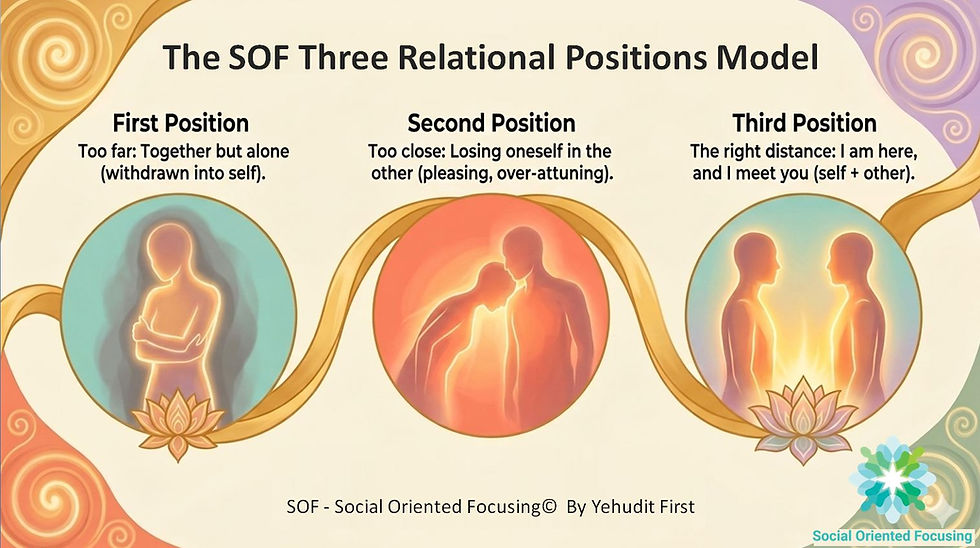
1. First Position: "Too Far" (Defensive Withdrawal)
In this position, we are "together, yet feeling alone". It is characterized by an inward contraction or preoccupation with the self, where the other is experienced as distant or unavailable. Somatically, this may manifest as boredom, anxiety, or a subtle dissociation; a protective self-preservation that creates a "mask" between selves.
2. Second Position: "Too Close" (Over-Attuned Fusion) Here, we are "together, but losing myself". Attention is excessively oriented toward the other’s needs or approval, leading to a disconnection from one’s own boundaries, needs, and internal anchoring. While often socially rewarded as caregiving, it creates a relational imbalance that diminishes vitality.
3. Third Position: "Right Distance" (Integrated Presence)
The third position is the embodiment of "Right Distance" - being together with full presence. It represents the capacity to remain inwardly connected to the felt sense while participating in authentic, reciprocal contact with the other. It enables autonomy without withdrawal and intimacy without fusion.
The Alchemy of Awareness: Bridging the Models
The spaces and the positions describe different aspects of experience. Being in the I-Space is not the same as withdrawing into the First Position; sensing the We-Space is not the same as losing oneself in the Second. The I & We-Space deepens and expands the experience of Right Distance in the Third Position: being connected to ourselves and to another person simultaneously.
When we recognize our current position, perhaps noticing the contraction of the First Position or the over-extension of the Second, we can give a name to a familiar experience: “Ah, this is where I am.” Through the Felt Sense, recognition itself can initiate movement, opening possibilities beyond our familiar reactions.

How does this interplay between the models unfold in everyday relationships?
From the First Position to Presence: I Have Myself
When I first began exploring the Three Relational Positions Model, I was surprised to discover how familiar the First Position was to me, particularly when I felt that others were looking at me critically. Later, I discovered that for many workshop participants, this was also their most familiar position.
In the First Position, we may be physically present in an interaction while inwardly withdrawing from it, as though lowering an invisible screen between ourselves and the other person. Sometimes this happens almost instantly; at other times, it is a gradual withdrawal from a relationship.
Even a tiny, almost imperceptible movement of withdrawal tends to affect the shared space. The other person may not know what has happened, yet may sense that something has changed in our presence.
Returning to the I-Space: I Have Myself
When I recognize that I have withdrawn, I can turn my attention inward, towards my body. I sense my boundaries, my spine, my feet on the ground, my breathing, and the support of my back.
Through this embodied connection, I return to myself.
I move from focusing on what I do not have in my relationship with the other person towards the tangible experience of what I do have, here and now: I have myself.
To me, one of the most important aspects of therapy and personal growth is this deep, embodied knowing that I have myself with me as I live my life, meet whatever life brings, and find my own way.
Returning to the I-Space does not mean getting rid of whatever has arisen in me. I step out of identification with one part of my experience and reconnect with the whole of who I am, a whole that is greater than the sum of its parts.
I have both a heart and a backbone, a soft belly and feet firmly on the ground. And I have a back that has my back.
From this connection, I can choose whether and how to open towards the other person. If I do, I can expand my presence into the I & We-Space: remaining rooted in myself while sensing the other person and the space between us.
Being “I” within the “We”.
Example: From Loneliness Within a Group to the Possibility of Connection
I am at a social gathering when suddenly I have the feeling that people are looking at me critically.
Almost without noticing, I withdraw inwardly. The screen comes down. I am still sitting with everyone, but I am no longer truly there with them. I become identified with a vulnerable part of myself and with the interpretation that perhaps I am not accepted or appreciated. The screen conceals that vulnerability so that no one can see it.
The moment I recognize the withdrawal, I turn my attention towards my body. I sense my spine, my feet on the ground, and the support of my back.
Gradually, I return to myself, reconnecting with the whole of who I am. I am aware of the vulnerability within me while also connected to my strength, wisdom, humour, and curiosity.
I have myself.
My breathing often becomes fuller, accompanied by a sense of release. Perhaps a spontaneous smile appears on my face. Perhaps I join the conversation, become interested in what someone is saying, or discover that I would actually prefer to remain quiet.
My system is no longer automatically reacting to the hurt created by my initial interpretation of the situation.
If I choose to open towards the encounter again, I can sense myself and the others simultaneously, listen with curiosity, and discover what is actually happening between us, beyond the story I have created.
And what if the other person really is being critical? Even then, I have myself. I can hear what is being said, sense whatever arises within me, remain connected to myself, and choose how I wish to respond.
The Couple's Dance Between Too Close and Too Far
A man who had been married for many years attended one of my SOF courses. During the second session, he became deeply moved and excited. Suddenly, through the Three Relational Positions Model, a familiar pattern in his marriage became clear to him.
He described his wife as warm, caring, opinionated, and very involved in his life. He, on the other hand, needed personal space and a sense that his boundaries were respected.
Whenever he felt that his boundaries were being crossed, he tended to withdraw inwardly, moving into the First Position: Too Far.
His withdrawal triggered his wife's concern. She would move closer, ask questions, and try to understand what was wrong. The more she tried to reach him, the more he withdrew.
She was in the Second Position, Too Close, while he was in the First Position, Too Far.
Eventually, she would become hurt, angry, and discouraged. Now she was the one withdrawing into the First Position.
As she pulled away, he would begin to feel guilty. He would emerge from his withdrawal and try to restore their connection. Now he was in the Second Position, while she remained in the First.
The harder he tried to reconnect, the further she withdrew, until he too became discouraged and retreated once again.
Now they were both in the First Position, each withdrawn into their own world. When the distance became unbearable for her, she would try to move closer again, and he would withdraw.
And the dance would begin all over again.
Stepping Out of the Dance: There Is Also a Third Position
For this participant, discovering that a Third Position existed was a revelation. For the first time, he could recognize the reciprocal movement between them: how his withdrawal triggered her need to move closer, and how her attempts to reconnect intensified his need for distance.
Sometimes moving directly from either of the first two positions into the Third Position is too great a step. The I-Space can offer another way.
Rather than immediately trying to change the relational dynamic, we can turn our attention towards our bodies and reconnect with our separate sense of self, our boundaries, our own centre, and our own wishes.
From there, we can expand our presence into the I & We-Space without giving up our sense of self. We can explore the Third Position, remaining grounded within ourselves while opening towards the other person and discovering the Right Distance between us.
Not a fixed distance, but a living one that changes from moment to moment and calls for ongoing sensing and adjustment.
The participant went on to practise with his wife. He later shared that their practice together had been deeply meaningful, although he did not share the details.
From Automatic Reactions to a Living Encounter
To illustrate what such a practice might look like, imagine a moment in which the couple manages to interrupt their familiar dance, remain present, and share their experiences as they unfold.
She: “When you withdraw and move away from me, I feel a coldness between us, as though you're leaving me. I become afraid of losing you, and I want to do everything I can to bring you back to me.”
He: “When you come so close, I feel as though I can't breathe. I sense resistance rising in me, and I close myself off even more. And when you move away, I feel that I've hurt you, and guilt arises.”
The very possibility of remaining present, sensing, and describing our experience as it unfolds already creates movement and change within us and in the space between us.
Listening to the other person's experience allows us to discover what lies beneath behaviour that previously only triggered our reactions. His withdrawal does not necessarily mean that he is rejecting her, just as her attempts to move closer do not necessarily mean that she is trying to control him.
Both are trying to protect themselves and their relationship, yet each needs something different to feel secure within it.
Becoming familiar with the two SOF models does not guarantee that this relational dance will disappear. It opens the possibility of recognizing the pattern while it is happening, reconnecting with ourselves, and exploring together how to create a shared space in which there is room for both of us.
No longer having to choose between being with myself and being with you, but discovering the possibility of being myself, together with you.


